Creatine: Not Just for Gym Bros (and Why Your Skin Loves It)
If you’ve ever heard the word creatine and immediately pictured a protein shaker, a squat rack, and a grunting man in a vest - you’re not alone 😅
Creatine has been aggressively branded as a muscle-building supplement for decades. But that reputation hides something really important:
Creatine is not a bodybuilding supplement. It’s a fundamental energy molecule.
And once you understand energy from a metabolic perspective, it becomes obvious why creatine can be incredibly supportive for skin health, especially dry, fragile, slow-healing, or stressed skin.
So let’s unpack it - without the gym bro nonsense.
Creatine: not just for gym bros!
What is creatine, really?
Creatine is a naturally occurring compound found in the human body. We make it ourselves (mainly in the liver and kidneys), and we also get small amounts from foods like meat and fish.
Its primary role is energy buffering.
Creatine helps recycle ATP - the energy currency of your cells - so your cells can keep doing their jobs efficiently, especially under stress.
That matters because:
👉 Skin is one of the most energy-demanding tissues in the body.
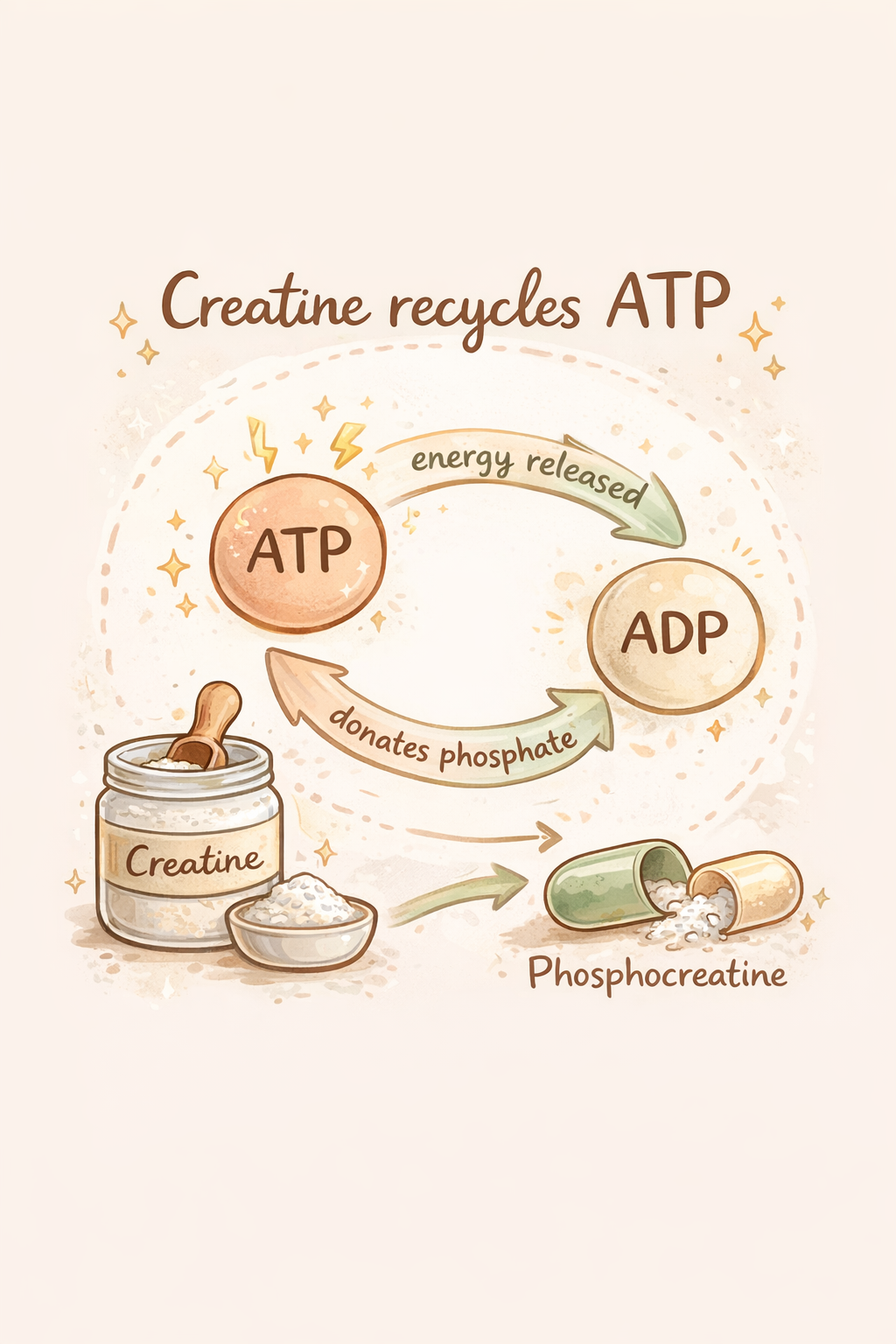
Creatine stores energy as phosphocreatine.
When a cell uses ATP and it drops to ADP, creatine helps recycle it back into ATP.
More ATP = more energy for repair, collagen production, barrier function & healing.
Skin health is an energy issue (not a moisturiser issue)
From a metabolic perspective, healthy skin depends on:
Adequate cellular energy (ATP)
Proper cell turnover and repair
Strong barrier function
Controlled inflammation
Good circulation and nutrient delivery
When energy production is low - due to stress, ageing, under-eating, hormonal shifts, inflammation, or nutrient deficiencies - skin is one of the first places to show it:
Dryness
Flakiness
Thinning skin
Poor healing
Inflammation
Sensitivity
Loss of elasticity
No amount of “active ingredients” can override a low-energy system.
This is where creatine quietly shines.
How creatine supports skin (metabolically speaking)
1. Creatine increases cellular energy availability
Creatine acts as a rapid energy reserve, helping cells regenerate ATP quickly.
For skin cells, that means:
Better barrier repair
Faster turnover of damaged cells
Improved resilience to environmental stress
More energy available for collagen and lipid synthesis
Skin that has energy behaves very differently to skin that doesn’t.
2. Creatine protects cells under stress
Creatine has been shown to help cells cope with:
Oxidative stress
Inflammation
UV exposure
Mechanical damage
From a metabolic view, stress drains energy. Creatine helps buffer that drain - which is especially relevant for skin constantly exposed to the environment.
Less stress + more energy = calmer, more resilient skin.
3. Creatine supports collagen and structure indirectly
Creatine doesn’t directly build collagen - but it supports the energy-dependent processes that do.
Collagen synthesis, skin repair, and tissue regeneration all require ATP. When energy is abundant, these processes run smoothly. When energy is scarce, they stall.
Think of creatine as helping keep the lights on so the repair work can actually happen.
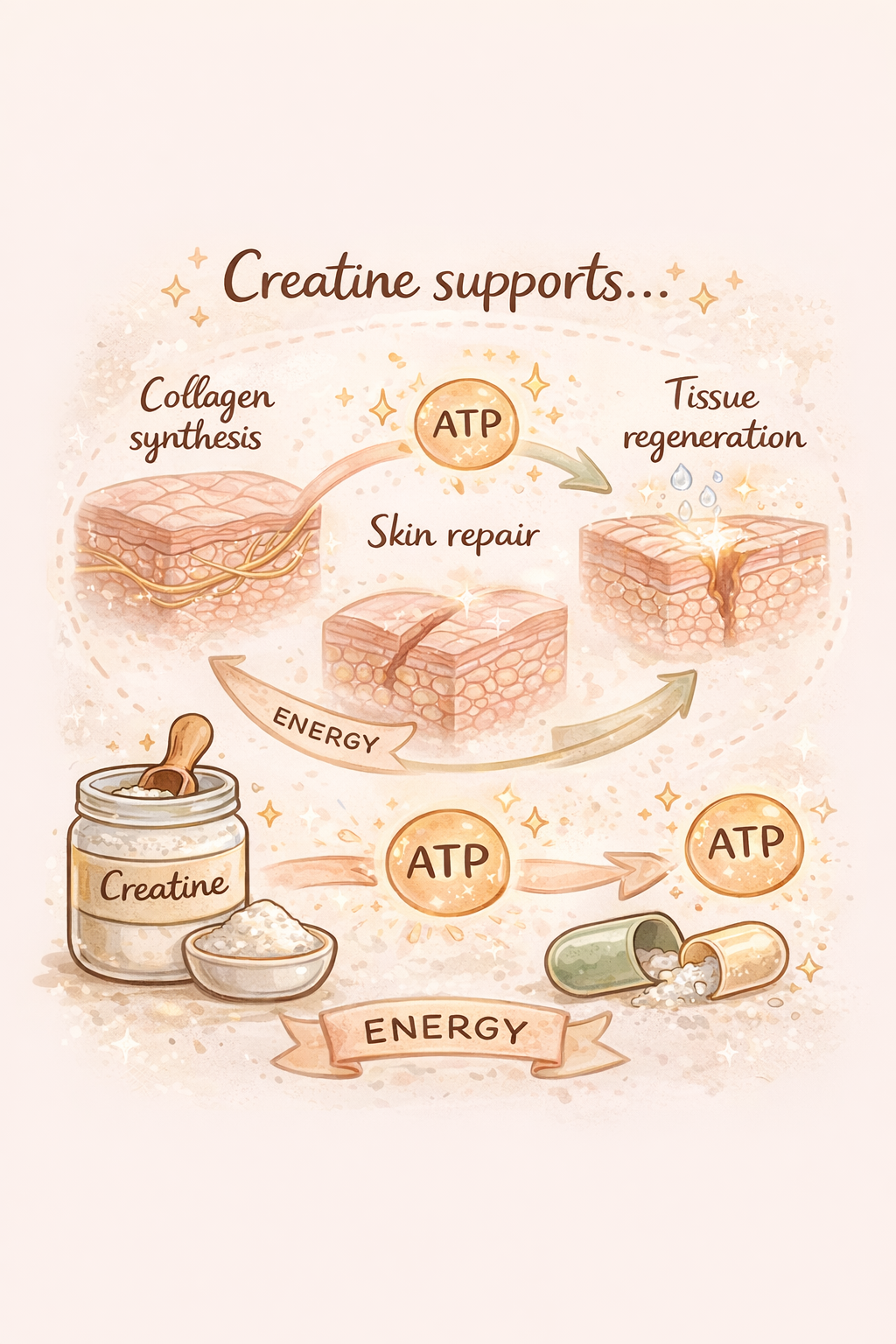
Creatine helps to support collagen synthesis and tissue regeneration by supporting these energy dependant processes.
4. Ageing skin is often energy-deficient skin
As we age, we tend to:
Lose muscle (a major creatine store)
Eat less protein
Experience more stress and inflammation
Produce energy less efficiently
That combination often shows up as thinning, fragile, slow-healing skin.
Creatine can be especially helpful here - not as a “beauty supplement”, but as metabolic support.
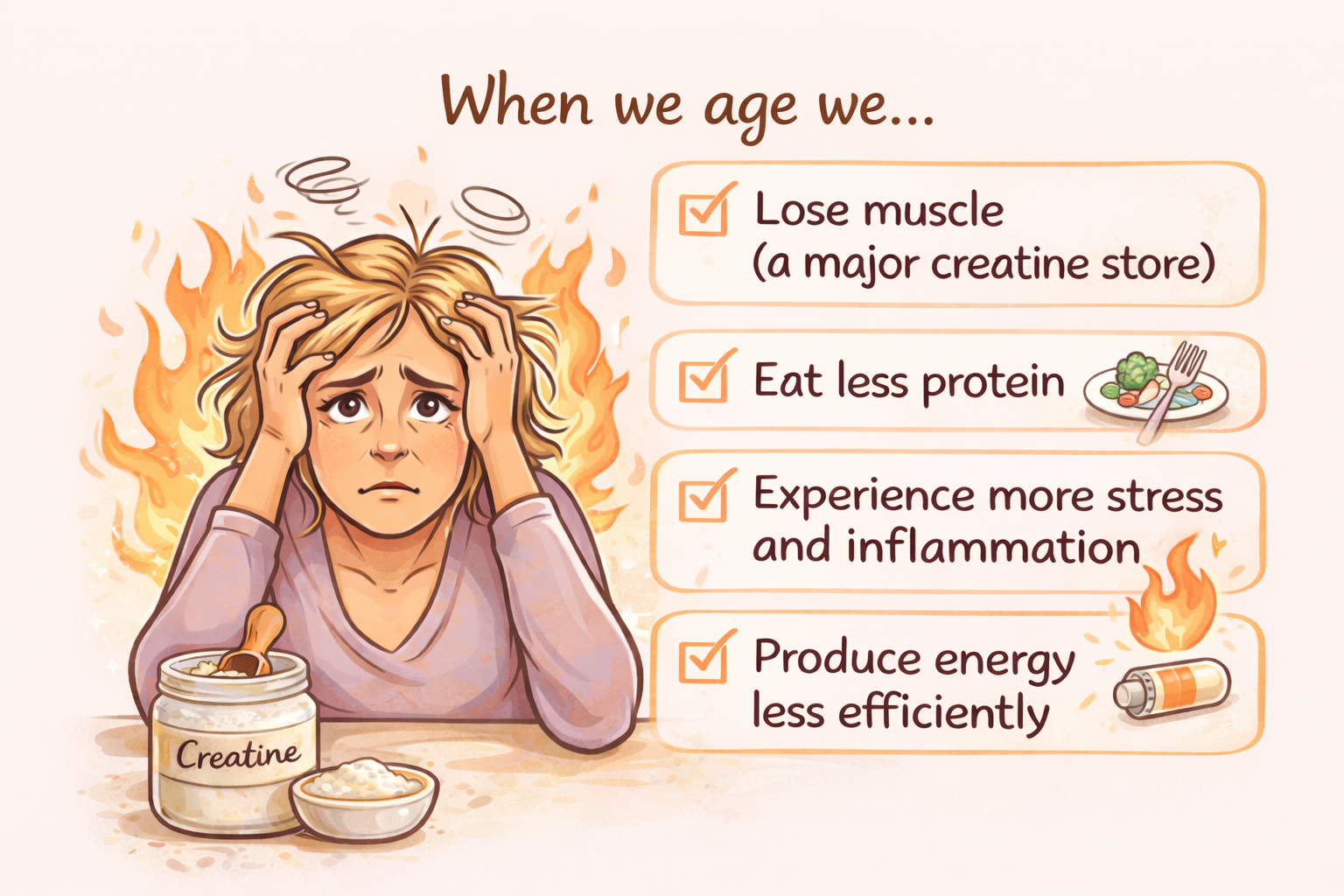
Creatine is helpful for metabolic support as we age.
Why creatine isn’t “just for gym bros”
Yes, athletes use creatine - because muscles burn through energy fast.
But so do:
Brain cells
Immune cells
Gut cells
Skin cells
Creatine doesn’t make you bulky.
It doesn’t “masculinise” you.
It doesn’t magically turn you into a weightlifter.
It simply supports energy production in tissues that need it.
Which is… all of them.
Creatine + skin care: inside and out
Topical skincare can support the skin barrier from the outside.
Nutrition and metabolism support it from the inside.
When skin has:
Enough energy
Enough raw materials
A low-stress internal environment
…it responds beautifully to good skincare.
Creatine fits perfectly into that “inside-out” approach.
Choosing quality matters
As with anything you put into your body, quality matters.
I’m very careful about where I source supplements from, and I personally get my creatine from Billy Craig because I trust the quality and purity of what he sells.
If you’re interested, this is the creatine I use:
👉 https://www.billycraig.co.uk/store/p/pre-order-creatine-monohydrate-powder-250g
(Simple creatine monohydrate, no fillers, no nonsense.)
Why this pairs perfectly with good skincare
Creatine supports energy from the inside.
But skin is always a two-way conversation.
Even if your cells are producing plenty of ATP, your skin barrier still needs the right raw materials on the outside - the kinds of fats and lipids it actually recognises and can use.
That’s where quality skincare matters.
When your body has:
Enough energy (ATP)
Enough protein
Enough micronutrients
Low inflammation
…and then you apply skincare rich in:
Saturated fats
Stearic acid
Palmitic acid
Barrier-supportive lipids
…you create the perfect environment for repair.
Energy allows repair to happen.
The right fats allow repair to hold.
Most conventional skincare acts like a temporary sealant. It sits on top. It softens briefly. Then the dryness returns.
But when you combine internal metabolic support (like creatine) with external barrier-supportive saturated fats, you’re not just masking dryness - you’re supporting structure, resilience and regeneration.
That’s why my body butter works so differently.
It’s not just moisturising.
It’s working with your physiology.
Creatine helps power the repair.
Saturated butters help build and protect the structure.
Inside and out.
If you’d like to try my handmade, saturated-fat-rich body butter for yourself, you can sign up at honestly.org.uk/first to get £10 off your first order.
Because skin doesn’t just need creams.
It needs energy - and the right building blocks.
Honestly ✨